Terraform vs Ansible: Which to Learn First?
[ info ] // Meta
Category
DevOpsA student once asked me the question every DevOps beginner asks: “Should I learn Terraform or Ansible first?” I had just spent a weekend teaching the Terraform workflow, and the week before that the Ansible one. The honest answer surprised him.
You are not choosing between two versions of the same tool. You are choosing which half of a two part job to learn first, and the answer depends on where your infrastructure starts.
This guide compares both tools side by side, shows how they actually fit together, and gives you a clear recommendation based on your role. By the end you will know which one to open first, and why learning both is eventually inevitable.
If you want the deep dive on either tool before reading on, my Terraform guide from scratch and my Ansible automation guide cover each one end to end.
The mental model: building versus furnishing
The fastest way to keep these two tools straight is an analogy.
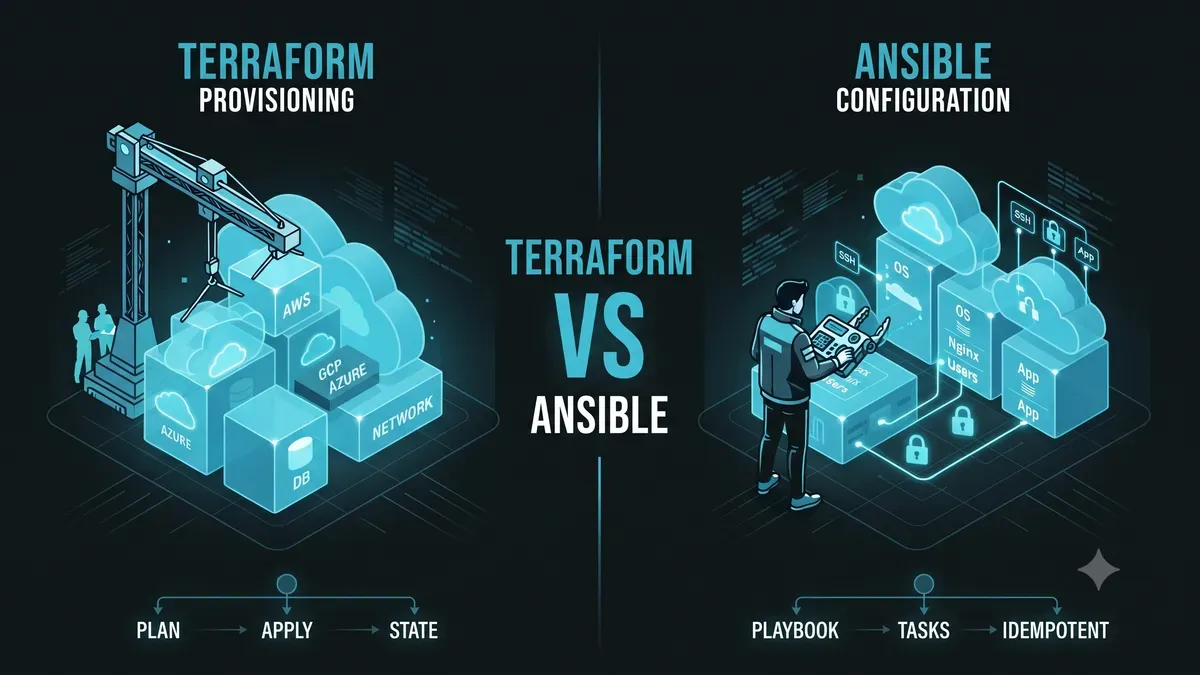
Terraform is the construction crew. It builds the house. It lays the foundation, erects the walls, installs the wiring, and creates the empty rooms. When it is done, the house exists.
Ansible is the interior designer. It walks into the finished house and furnishes it. It installs the software, writes the configuration files, starts the services, and makes each room usable.
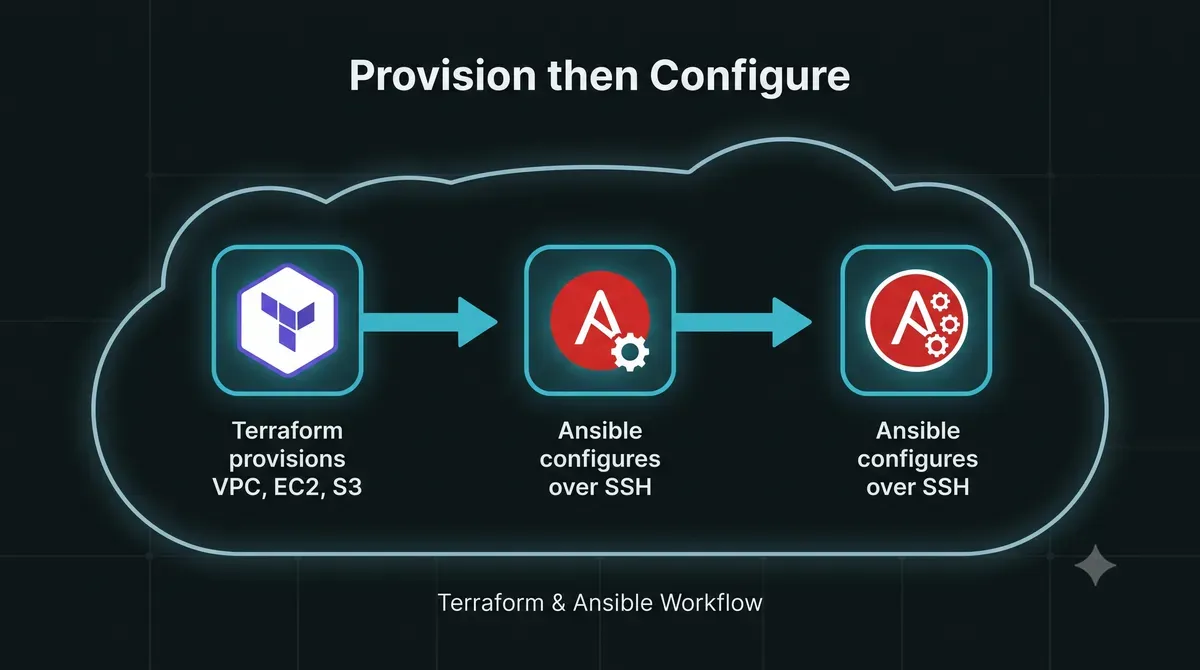
The key insight is the order. Terraform creates the infrastructure, Ansible configures what runs on it. In technical terms, Terraform is a provisioning tool and Ansible is a configuration management tool.
That single sentence answers most of the confusion between them.
What each tool actually does
Terraform provisions infrastructure
Terraform talks to cloud provider APIs, AWS, GCP, Azure, and hundreds of others, and creates resources with code. An EC2 instance, an S3 bucket, a VPC, a database. You write the desired state in HCL, Terraform figures out the difference between what exists and what you declared, and it applies the change.
Its superpower is drift detection. If someone clicks in the console and changes a security group, terraform plan shows the difference between reality and your code. The code is the source of truth, and Terraform is the referee that keeps reality honest.
Ansible configures servers
Ansible connects to existing servers over SSH, with no agent installed on the target, and brings them to a desired state. Install Nginx, copy a configuration file, restart a service, create a user. You write a playbook in YAML, Ansible executes it over SSH, and it reports whether each task changed anything.
Its superpower is idempotency. Run the same playbook ten times and it does the right thing every time. If Nginx is already installed, it says “ok” and moves on. This is what makes configuration management safe to automate.
Side by side comparison
| Dimension | Terraform | Ansible |
|---|---|---|
| Core job | Provision infrastructure | Configure existing servers |
| Language | HCL (declarative) | YAML playbooks (declarative) |
| Connection | Cloud provider APIs | SSH to target servers |
| Agent needed | No | No (agentless) |
| State tracking | Yes, state file | No central state |
| Drift detection | Yes, terraform plan | Manual via check mode |
| Best at | Creating VMs, networks, storage | Installing packages, configs, services |
| Typical use | ”Build me a VPC with two subnets" | "Make Nginx run on this server” |
| Learning curve | Steeper (state, providers, modules) | Gentler (plain YAML) |
The rows that matter most are “core job” and “state tracking”. Terraform needs a state file because it must remember what it created to manage it later. Ansible does not create resources, it changes the state of resources that already exist, so it has nothing to track.
Where they overlap and where they do not
The confusion starts because the two tools sometimes look like they do the same thing.
Both can install software. Ansible does it natively with its package modules. Terraform can do it too, with a remote exec provisioner, but it is clunky and most people avoid it. If your job is software installation, that is Ansible territory.
Both can create cloud resources. Terraform does it natively. Ansible has cloud modules that can create EC2 instances, but using Ansible as a provisioning tool is like driving a nail with a wrench. It works, and it is the wrong tool.
The clean rule of thumb: if it involves creating or destroying infrastructure, use Terraform. If it involves configuring or maintaining infrastructure that already exists, use Ansible.
Why they complement instead of compete
Here is the part that changes how you plan your learning. In a real deployment, you almost always use both.
A typical production setup looks like this:
- Terraform provisions the VPC, subnets, the EC2 instance, and the security groups.
- Ansible connects to that instance and installs Nginx, deploys the application, and configures the firewall.
- The same pair repeats for every environment, staging and production, with identical results.
A concrete example. Terraform creates the instance and outputs its public IP. Ansible uses that IP as the target in its inventory.
# Terraform: provision the server
resource "aws_instance" "web" {
  ami           = "ami-0abc123"
  instance_type = "t3.micro"
  tags = { Name = "web-prod" }
}

output "web_ip" {
  value = aws_instance.web.public_ip
}
# Ansible: configure the server at that IP
- name: Set up web server
hosts: web
become: yes
tasks:
- name: Install Nginx
apt:
name: nginx
state: latest
- name: Deploy the app
copy:
src: app.conf
dest: /etc/nginx/sites-available/Terraform builds the machine, Ansible makes it useful. Neither step is optional in a mature pipeline.
Which one to learn first
The honest answer depends on where you are coming from, and I will give you the decision framework instead of a one size fits all order.
Learn Terraform first if you are a developer or you work where cloud accounts are created from scratch. You will feel the payoff immediately, every resource you click in the console today becomes five lines of code tomorrow. The cloud pillar of my cloud learning guide is built around this path. If you are starting with a fresh account, check your AWS free tier status first, so the free allowance actually covers your early resources.
Learn Ansible first if you are a system administrator managing existing servers. Your daily work is already configuration, patching, installing, fixing. Ansible automates the exact toil you do by hand, and you feel the time savings on day one.
If you are truly starting from zero, start with Ansible. Its gentler learning curve gives you a win within hours, which builds the momentum you need before Terraform’s steeper concepts, state files, providers, and modules.
Either way, the second tool comes eventually. They are not rivals for your attention, they are two halves of the same automation stack.
Common mistakes when choosing
Three mistakes I see repeated by learners and teams.
- Treating them as interchangeable. Picking one and forcing every job through it. The result is an Ansible playbook that awkwardly creates AWS resources, or a Terraform remote exec that fights to install a package. Use each for what it is built for.
- Skipping the foundation. Jumping into Terraform without understanding VPCs and IAM, or into Ansible without basic Linux administration. Both tools automate infrastructure, they do not replace understanding it.
- Learning by watching only. Comparisons like this one are a map, not the territory. The distinction between provisioning and configuration clicks when you have actually provisioned something with one tool and configured it with the other.
FAQ
Do I need both? In production, yes. Terraform builds, Ansible configures, and mature teams use both in sequence. As a beginner, learn one well, then add the other.
Is Ansible dying? No. It remains the most widely used configuration management tool, and its agentless model keeps it popular where agents are impractical.
Can Terraform replace Ansible entirely? Not cleanly. Terraform can trigger configuration through provisioners, but it is not a configuration management tool and most teams do not use it that way.
Which has better job prospects? Both appear constantly in DevOps and cloud roles, often in the same job description. Knowing both is the differentiator, and this comparison is the map to getting there.
How long does it take to learn each? Most people get productive with Ansible within a few days of focused practice, since playbooks read like plain English. Terraform usually takes a week or two longer, because you also need to understand state files and how providers map to real cloud resources. Two weeks of consistent practice is enough to see which one feels natural.
Closing
The student who asked the question started with Ansible because he managed existing servers. A month later he was writing Terraform for new projects. The tools did not compete, they took turns.
Learn to build with Terraform and to configure with Ansible, and you stop being the person who clicks in the console. You become the person who writes the blueprint and the instruction manual, and that is the whole job.
I hope this Terraform vs Ansible comparison helps you choose the right first step.
Implementation Checklist
- Replicate the steps in a controlled lab before production changes.
- Document configs, versions, and rollback steps.
- Set monitoring + alerts for the components you changed.
- Review access permissions and least-privilege policies.
Official References
Need a Hand?
If you want this implemented safely in production, I can help with assessment, execution, and hardening.
Contact MeDeploy on Cloud Infrastructure with $200 Free Credit
Spin up high-performance SSD cloud Droplets, managed Kubernetes, and databases in seconds. Test your containers and production workloads with $200 in free credits.
Transparency: We independently test and operate all recommended infrastructure. If you use our partner links, you receive free promotional credits and support our testing lab at zero extra cost to you.
Weekly Production DevOps Runbooks
Join 1,000+ infrastructure engineers receiving real-world Linux troubleshooting, Proxmox clustering setups, and Docker optimization runbooks every Tuesday. Zero spam, unsubscribe anytime.

About the Author
Kamandanu Wijaya
IT Infrastructure & Network Administrator
Infrastructure & network administrator with 15+ years of enterprise experience, focused on stability, security, and automation.
Certifications: Google IT Support, Cisco Networking Academy, DevOps.
Hybrid Cloud Migration: No Downtime
next →Proxmox Security: Patch Critical CVEs Without VM Downtime
Need IT Solutions?
DoWithSudo is ready to help setup servers, VPS, and your security systems.
Contact Us