DeepSeek V4.1 Flash: How the 890-Byte KV Cache Works
On September 11, 2026, Hangzhou DeepSeek Artificial Intelligence Basic Technology Research Co. Ltd. released DeepSeek-V4.1-Flash. The open-weight model represents the smallest entry in DeepSeek’s new architecture family, featuring 552 billion backbone parameters, native multimodal understanding, and support for context windows up to one million tokens.
The central engineering objective of this release is compressing context memory. As long-horizon autonomous agents and tool-use workflows expand, large language model workloads have become heavily input-dominated. Prefill computation and massive Key-Value (KV) caches create severe bottlenecks across High Bandwidth Memory (HBM) capacity, solid-state drive (SSD) storage, and data-transfer bandwidth.
DeepSeek-V4.1-Flash addresses these bottlenecks by redesigning the Transformer memory pipeline. Through a Causal Encoder-Decoder (CED) architecture, Compressed Sparse Attention 2 (CSA2), FP4 cache quantization, and SWA Bounded Replay, the model reduces its global KV cache footprint to 890 bytes per token. This represents a 3.9-fold reduction from DeepSeek-V4-Flash and a 437-fold reduction compared to DeepSeek-V1.
Alongside the architectural release, DeepSeek announced that its previous flagship, DeepSeek-V4-Pro, is being retired. Starting September 14, 2026, at 04:00 UTC, all requests sent to the V4-Pro API endpoint will be routed to V4.1-Flash and billed at Flash rates, reducing output token prices by approximately 70 percent. The model weights are published on Hugging Face under the MIT license, and the system is live across DeepSeek’s web platform, mobile applications, and partner developer environments.
This technical analysis examines the architectural specifications, infrastructure optimizations, benchmark evaluations, and cloud economics detailed in DeepSeek’s technical report and official release documentation.
The Asymmetric MoE Profile: 8B Prefill vs 16B Decode
DeepSeek-V4.1-Flash is structured as an asymmetric Mixture-of-Experts (MoE) Transformer. The complete model integrates 552 billion parameters within its language backbone, accompanied by 196 billion parameters in an offloaded conditional memory module called Engram.
Unlike symmetric architectures where the active parameter count remains identical across all execution stages, V4.1-Flash activates different parameter volumes based on the operational phase:
DeepSeek-V4.1-Flash Parameter Allocation:
+------------------------------------------------------------------------+
| Total Language Backbone Parameters: 552 Billion                        |
| Engram Host Memory Parameters: 196 Billion                             |
| Expert Topology: 384 Routed Experts + 1 Shared Expert                  |
+------------------------------------------------------------------------+
| Execution Phase    | Active Parameters | Expert Routing Mechanism      |
+--------------------+-------------------+-------------------------------+
| Input Prefill      | 8 Billion         | 6 Routed Experts + 1 Shared   |
| Output Generation  | 16 Billion        | 6 Routed Experts + 1 Shared   |
+--------------------+-------------------+-------------------------------+
The MoE backbone retains the shared and routed expert configuration of DeepSeekMoE. Each MoE layer incorporates one shared expert, which processes every token, and 384 finely routed experts. For each token, the routing gate selects six routed experts.
The model was pretrained on a multimodal corpus comprising 45 trillion tokens from scratch. The context window was extended to one million tokens at the 34-trillion token mark.
The decision to activate only 8 billion parameters during prefill directly targets agentic workloads. In multi-turn coding and systems administration workflows, incoming prompt volume dominates overall token traffic. An agent regularly ingests large code repositories, documentation trees, and diagnostic command histories before generating concise terminal commands or code patches.
By restricting prefill activation to 8 billion parameters, the architecture reduces the computational cost of ingesting long prompt contexts before token generation begins.
Causal Encoder-Decoder: Halving Prefill Computation
The foundational structural change in DeepSeek-V4.1-Flash is the Causal Encoder-Decoder (CED) architecture, adapted from concepts introduced in YoCo (You Only Cache Once).
Standard generative language models employ decoder-only architectures. In a 40-layer decoder-only Transformer, every token in the prompt passes through all forty layers sequentially, computing self-attention keys, values, and feed-forward updates at every layer. This requires each layer to maintain its own independent KV cache slice.
DeepSeek-V4.1-Flash organizes its 40 causal Transformer layers into two distinct 20-layer stages, placing a 20-layer causal encoder directly before a 20-layer decoder.
Causal Encoder-Decoder (CED) Execution Flow:

Input Token Sequence [N tokens]
       │
       ▼
+────────────────────────────────────────────────────────+
| Causal Encoder (Layers 1 to 20)                        |
| - Computes full causal attention & SWA                |
| - Emits final encoder hidden state: H_20               |
+────────────────────────────────────────────────────────+
       │
       ├─────────────────────────────────────────┐
       │ (H_20 State Vector)                     │ (H_20 State Vector)
       ▼                                         ▼
+──────────────────────────────+   +──────────────────────────────+
| Linear Projection Matrix     |   | Linear Projection Matrix     |
| C_l = H_20 * W_l_KV          |   | Z_l = H_20 * W_l_Z           |
+──────────────────────────────+   +──────────────────────────────+
       │                                         │
       └────────────────────┬────────────────────┘
                            ▼
           Consolidated Global KV Cache for Decoder
                            │
       ┌────────────────────┴────────────────────┐
       ▼                                         ▼
+────────────────────────────────────────────────────────+
| Decoder (Layers 21 to 40)                              |
| - Directly consumes projected Global KV cache          |
| - Bypasses per-layer global attention prefill passes   |
| - Computes localized Sliding Window Attention (SWA)    |
+────────────────────────────────────────────────────────+
For global attention, the bottom twenty layers operate as a causal encoder. When input tokens are processed, the encoder evaluates attention and local sliding window attention (SWA) up to layer twenty, emitting a final hidden state designated as H_20.
The upper twenty layers (the decoder) do not calculate their global KV entries from their own layer-specific hidden states. Instead, global KV states for layers twenty-one through forty are projected directly from H_20 using fixed projection matrices:
C_l = H_20 * W_l_KV
Z_l = H_20 * W_l_Z    (for decoder layer l > 20)
In this formulation, C_l represents the key-value entries for decoder layer l, and Z_l represents the corresponding compression projection weights.
During the prefill phase, the system executes full computation only through the first twenty layers. The global KV cache for the top twenty layers is constructed through linear matrix projections of H_20. The input prompt tokens completely bypass the multi-layer attention operations of the upper twenty layers.
For input sequences where total token count N is much larger than the local sliding window size n_win, prefill computational complexity drops from standard O(N * L) down to approximately O(N * L / 2).
This structural design cuts prefill floating-point operations by half, doubling prompt-processing throughput on equivalent hardware.
The 890-Byte Footprint: Compressed Sparse Attention 2 and FP4
While CED halves prefill computation, serving large context windows requires minimizing memory consumption in hardware.
In DeepSeek-V1, deployed in November 2023, the global KV cache consumed 389,120 bytes per token. Across four model generations, DeepSeek compressed this footprint through progressive architectural innovations.
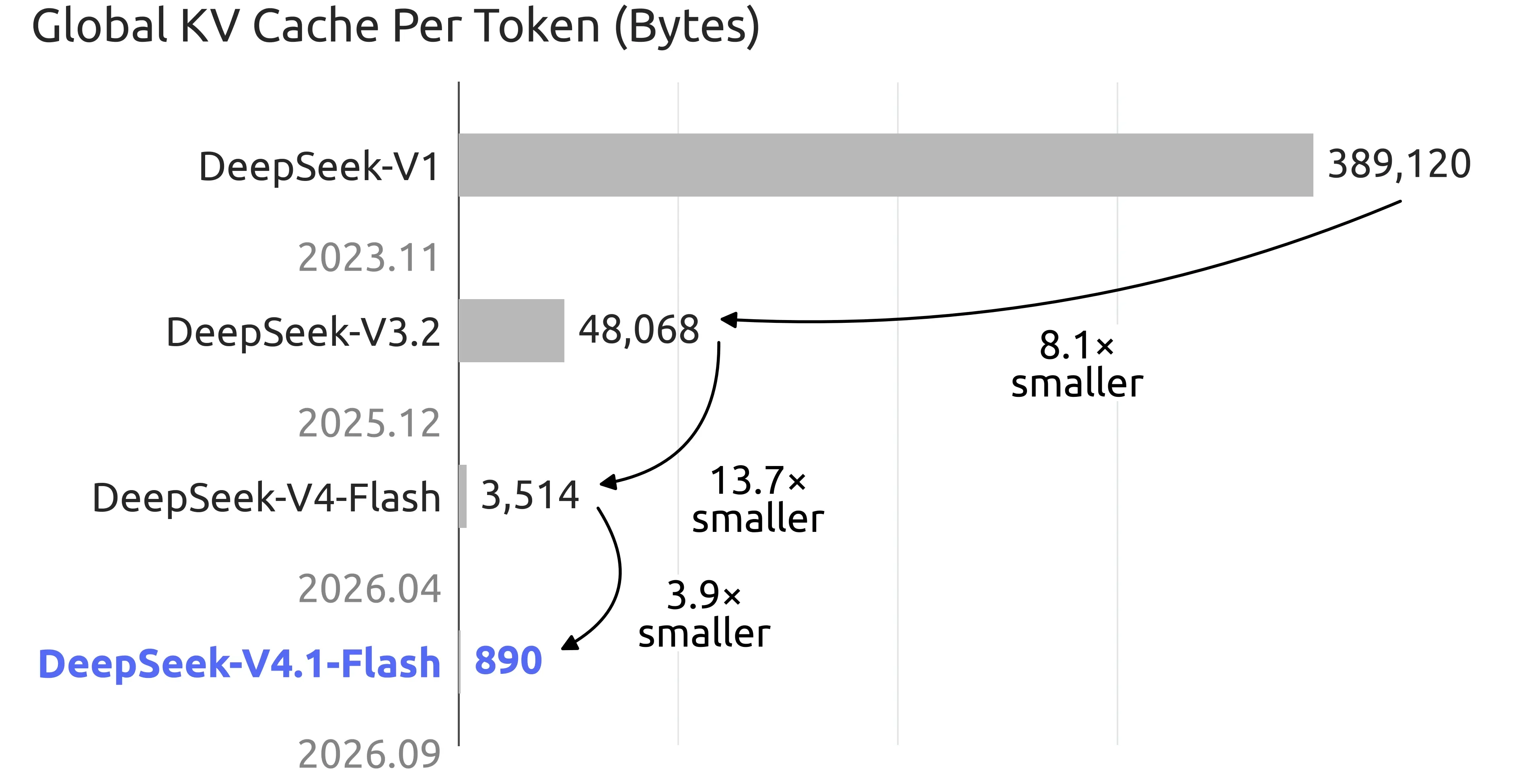
In DeepSeek-V3.2, Multi-Head Latent Attention (MLA) compressed the cache to 48,068 bytes (an 8.1-fold reduction). DeepSeek-V4-Flash introduced Compressed Sparse Attention, reducing it to 3,514 bytes (a 13.7-fold reduction).
In DeepSeek-V4.1-Flash, the global KV cache footprint drops to 890 bytes per token, achieving a 3.9-fold reduction from V4-Flash and a 437-fold reduction from V1.
This compression is achieved by combining Compressed Sparse Attention 2 (CSA2), Hierarchical Sparse Indexing, and native FP4 quantization.
The Three Operating Modes of CSA2
Serving long context requires controlling three dimensions: entry size, sequence length, and layer depth. CSA2 addresses all three dimensions by assigning each layer one of three static operational modes:
- Full Mode. The layer executes the complete attention path. It computes its own main KV and indexer queries, projects indexer keys from main KV, and runs the indexer to produce fresh Top-K indices.
- Reindex Mode. The layer reuses the main KV and indexer keys from the preceding Full Mode layer. However, it computes its own indexer query and rescores the reused keys, generating new Top-K indices tailored to the current layer.
- Reuse Mode. The layer reuses both the main KV and the Top-K indices computed by the previous indexing layer. It performs attention against the selected tokens without computing indexer queries or evaluating index scores.
CSA2 Operating Modes:
┌─────────────────┬─────────────────┬─────────────────┬──────────────────┐
│ Mode            │ Main KV Source  │ Indexer Keys    │ Top-K Indices    │
├─────────────────┼─────────────────┼─────────────────┼──────────────────┤
│ Full Mode       │ Computed Fresh  │ Computed Fresh  │ Computed Fresh   │
│ Reindex Mode    │ Reused Preceding│ Reused Preceding│ Rescored Locally │
│ Reuse Mode      │ Reused Preceding│ Reused Preceding│ Reused Directly  │
└─────────────────┴─────────────────┴─────────────────┴──────────────────┘
Because layers in Reuse Mode skip index scoring entirely, memory traffic between processor cores and local cache structures drops significantly. In the decoder, layers operating in Reuse Mode execute using only eleven fused CUDA kernels during token decode.
Hierarchical Sparse Indexer
In standard sparse attention, even when indices are shared across layers, indexers must evaluate similarity scores across the full sequence length. For ultra-long contexts, this repeated scoring introduces an operational bottleneck.
DeepSeek introduced the Hierarchical Sparse Indexer specifically for the CED decoder.
The first Full Mode layer in the decoder evaluates the causally visible context to determine its Top-512 indices. Simultaneously, it executes blockwise candidate selection, grouping tokens into blocks of eight, assigning each block the maximum index score among its positions, and gathering the top 2,048 blocks into a candidate pool of 16,384 positions.
Subsequent layers in Reindex Mode do not scan the entire context sequence. They restrict their search to the pre-filtered candidate pool of 16,384 positions.
This bounds the per-query computation of deeper indexers to a constant candidate pool size, independent of total context length.
FP4 Precision on the Main Cache
To further reduce memory overhead, DeepSeek extended quantization-aware training (QAT) to the main KV cache, converting it to FP4 precision.
The model adopts the OCP-standard MXFP4 format, utilizing an E2M1 encoding (two exponent bits, one mantissa bit) with one E4M3 scale factor per sixteen channels.
MXFP4 Cache Precision Layout:
[ 16 Channels of FP4 Data (E2M1) ] ───> Scaled by ───> [ 1x E4M3 Scale Factor ]
(Each channel allocated 4 bits)                        (Shared across 16 channels)
In DeepSeek-V4.1-Flash, the L2 norm of the 512-channel KV latent following RMS normalization is mathematically bounded by the square root of 512, which is approximately 22.6. Rotary Position Embeddings (RoPE) preserve vector norms, ensuring that channel magnitudes rarely exceed twenty-three in practice. The maximum magnitude observed during training was approximately 10, well within the E2M1 dynamic range of 2,688.
Because the dynamic headroom accommodates vector bounds, DeepSeek omitted the secondary global scale factor used in standard NVFP4. This simplifies the memory layout and allows values to be dequantized directly in registers before attention execution.
Quantizing the main KV cache to FP4 cuts physical HBM storage consumption by nearly half compared to FP8. Sliding Window Attention (SWA) KV retains FP8 precision due to its higher sensitivity to quantization noise.
Persistent Storage Optimization: SWA Bounded Replay
In large-scale serving systems, high-bandwidth GPU memory cannot hold all active session states. Inactive session prefixes are tiered to host DDR5 system memory and persistent NVMe enterprise storage.
In DeepSeek-V4, this tiering structure encountered a critical bottleneck.
Transformer layers combine Global Attention (covering the full context history) with Sliding Window Attention (SWA, covering only the most recent 128 tokens).
Global KV entries have long-tail reuse value. A codebase prefix uploaded by an engineer will be referenced across multiple queries over several days. In contrast, SWA entries are short-lived, capturing local syntactic context that becomes dead shortly after an active session pauses.
In DeepSeek-V4, persistent storage systems cached Global KV and SWA KV together on NVMe SSDs. SWA entries accounted for nearly fifty percent of persistent SSD storage capacity. Caching SWA on SSD created severe write amplification, exhausting drive write endurance on data that was rarely re-read.
Persistent KV Cache Tiering Pipeline:

                Incoming Agent Request
                          │
                          ▼
       ┌──────────────────────────────────────┐
       │ In-Memory Host DRAM Pool (Short TTL) │
       └──────────────────┬───────────────────┘
                          │
           ┌──────────────┴──────────────┐
           ▼                             ▼
      [ SWA Hit ]                   [ SWA Miss ]
           │                             │
           │ (Proceed to decode)         ▼
           │                ┌───────────────────────────┐
           │                │ Persistent NVMe Storage   │
           │                │ (FP4 Global KV Only)      │
           │                └────────────┬──────────────┘
           │                             │
           │                    ┌────────┴────────┐
           │                    ▼                 ▼
           │               [Global Hit]      [Global Miss]
           │                    │                 │
           │                    ▼                 ▼
           │             Execute Encoder     Full Prefill
           │             SWA Bounded Replay  (Recalculate)
           │             (Only n_win tokens)
           ▼                    ▼
     Execute Autoregressive Output Generation
DeepSeek-V4.1-Flash restructures persistent cache management through three engineering rules:
- SWA KV is excluded from persistent SSD storage. SWA states are routed to a distributed memory pool provisioned from ten percent of host system DRAM on each node. These entries carry minute-scale time-to-live (TTL) limits and are recycled rapidly.
- Persistent NVMe storage holds only compressed FP4 Global KV. Because Global KV is compressed and SWA is removed, persistent storage requirements on SSD drop to one-eighth of the DeepSeek-V4-Flash footprint. Global KV entries are maintained on SSD with a guaranteed retention lifetime of at least 72 hours under LRU eviction policies.
- Encoder SWA Bounded Replay handles transient cache misses.
When a multi-turn request encounters a Global KV hit on SSD but an SWA miss in DRAM, the system must regenerate the localized window state.
Under conventional implementations, exact reconstruction of SWA states across forty layers requires executing a forward pass across L * n_win tokens (exceeding 5,000 tokens for forty layers).
DeepSeek demonstrated that the effective receptive field of SWA does not compound across the full depth of the network. Under SWA Bounded Replay, when a request hits Global KV but misses SWA, the engine replays only the final n_win tokens of the cached prefix (128 tokens). It recalculates localized SWA states for that segment, attaches the persistent Global KV, and begins decoding.
This design reduces persistent SSD capacity requirements by 87.5 percent while keeping prefix restoration latency minimal.
Engram Conditional Memory: 196B Parameters in Host DRAM
A secondary scaling constraint in large language models is parameter bloat caused by factual memorization.
When language models memorize entity dates, API signatures, and static reference data, that information is stored in the weights of feed-forward layers. Allocating expensive high-bandwidth GPU memory for static factual lookup tables represents an inefficient use of memory hierarchy.
DeepSeek decoupled factual memorization from active computation by integrating Engram Conditional Memory.
Engram Conditional Memory Architecture:
+───────────────────────────────────────────────────────────────+
| Host System Memory (Enterprise DDR5 via RDMA Fabric)          |
| 196 Billion Parameters in FP8 Precision                       |
| - N-gram evaluation orders: {2, 3, 4}                         |
| - 8 Hash Heads per order                                      |
| - 16 Million Prime-sized lookup buckets per head              |
+───────────────────────────────────────────────────────────────+
                               │
            Deterministic Hash │ Background RDMA Transfer
            Lookup             │ (Prefetched during Block 0)
                               ▼
+───────────────────────────────────────────────────────────────+
| Accelerator High-Bandwidth Memory (HBM3e)                     |
| Context-Aware Gating Module (Layers 1 and 14)                 |
| - Filters irrelevant factual representations                  |
| - Injects gated embeddings into residual stream               |
+───────────────────────────────────────────────────────────────+
Engram assigns 196 billion parameters across two modules placed at layers one and fourteen of the language backbone. These parameters reside entirely in standard host system DRAM rather than on the GPU.
The module inspects n-gram token combinations of orders two, three, and four. It utilizes eight independent hash heads per order, with each head indexing lookup tables containing approximately sixteen million entries sized using distinct prime numbers. Both the embedding tables and projection matrices are stored in FP8 precision.
Because n-gram hashing is deterministic, the memory addresses required for lookup are identified immediately upon tokenization.
During inference, the runtime system initiates asynchronous Remote Direct Memory Access (RDMA) transfers across PCIe and network interconnects to prefetch target embeddings from host DRAM. The transfer for the initial module executes concurrently with the computation of Transformer block zero.
Once embeddings reach accelerator memory, a context-aware gating layer assesses whether the prefetched factual representations are relevant to the active sequence. If the gate activates, the embedding vector is integrated into the residual stream. If not, it is discarded.
To control optimizer memory during training, DeepSeek optimized the Engram embedding tables using momentum-based updates followed by Sinkhorn balancing rather than Adam, significantly reducing training memory overhead.
Inference Optimization and DSpark Speculative Decoding
Memory optimization is coupled with execution speed through kernel fusion and speculative decoding.
Through fused kernels, DeepSeek encapsulated complex attention operations inside a small number of optimized execution paths:
- The fused-RoPE-attention-RoPE-cast kernel in FlashMLA.
- The Mega-Gate, Mega-mHC, and Mega-MoE kernels in DeepGEMM.
- The TileKernels suite and the TopK kernel in DeepSelect.
Consequently, Transformer layers operating in Reuse Mode execute with only fifteen kernels during prefill and eleven during decode.
Single-Pass mHC
In DeepSeek-V4, mHC maintained n residual streams between blocks, requiring three sequential kernels due to data dependencies, which produced activation memory traffic of (4n + 4)d.
In DeepSeek-V4.1-Flash, Single-Pass mHC shifts input-mixing coefficients by one block:
X_{l+1} = B_l * X_l + C_l * F_l(A_{l-1} * X_l)Because input mixing consumes coefficients A_{l-1} generated by the previous block, the sequential dependency disappears. In production deployment, residual updating, input mixing, and coefficient prediction are fused into a single Mega-mHC kernel, reducing activation memory traffic to (2n + 2)d and halving memory bandwidth overhead.
DSpark Speculative Decoding
To accelerate token generation without encountering suffix decay, DeepSeek equipped the model with DSpark.
DSpark Semi-Autoregressive Drafting Pipeline:

Input Context Stream
         │
         ▼
+─────────────────────────────────────────────────────────+
| 3-Layer Transformer Drafter (128-token Sliding Window)  |
| - Computes base logits for 5 draft positions in parallel|
| - Lightweight Markov head models inter-token covariance |
+─────────────────────────────────────────────────────────+
         │
         ▼
+─────────────────────────────────────────────────────────+
| Dynamic Confidence Verification Scheduler               |
| - Estimates per-position conditional acceptance rates   |
| - Evaluates prefix survival probability distributions   |
| - Dynamically truncates verification length by load     |
+─────────────────────────────────────────────────────────+
         │
         ▼
Primary Model Verification (Single Batched Evaluation)
DSpark employs three Transformer blocks configured with a 128-token sliding attention window. A single forward pass generates base logits for five draft positions in parallel.
A lightweight Markov head models statistical dependencies between draft tokens, while a confidence estimation head predicts conditional acceptance probabilities for each candidate position.
The DSpark scheduler evaluates survival probabilities against real-time server load profiles. When hardware utilization is high and late-stage token confidence is low, the scheduler truncates the draft length to two tokens. When confidence metrics are robust, it submits the full five-token draft.
In benchmark deployments, DSpark achieves generation throughput up to 120 tokens per second on optimized hardware, with community testers recording first-token thinking latency around 0.3 seconds and end-to-end response times around 0.8 seconds for standard requests.
Native Multimodal Architecture: DeepSeek-ViT
DeepSeek-V4.1-Flash integrates native multimodal processing trained from the initial pretraining stage.
The visual pathway utilizes DeepSeek-ViT, designed with 2D Rotary Position Embeddings (2D-RoPE) to accommodate variable image aspect ratios without cropping or dimensional distortion. Patch embedding layers use linear projections rather than standard convolutions, maintaining compatibility with the Muon optimization framework.
A 3x3 pixel-unshuffle operation downsamples the input visual grid by a factor of nine prior to passing representations into the projection MLP. This reduction allows the model to process high-resolution technical diagrams and interface screenshots up to 1344x1344 pixels without overwhelming the sequence context with visual tokens.
On multimodal evaluation suites, V4.1-Flash achieved scores of 95.6 on DocVQA, 86.0 on RefCOCO, and 56.5 on MMMU-Pro, providing native parsing of architecture diagrams, terminal screen captures, and document layouts.
Benchmark Evaluation: Systems, Reasoning, and Frontier Comparisons
DeepSeek’s technical report details performance across reasoning suites, agentic benchmarks, and software engineering evaluations relative to both open and closed frontier models.
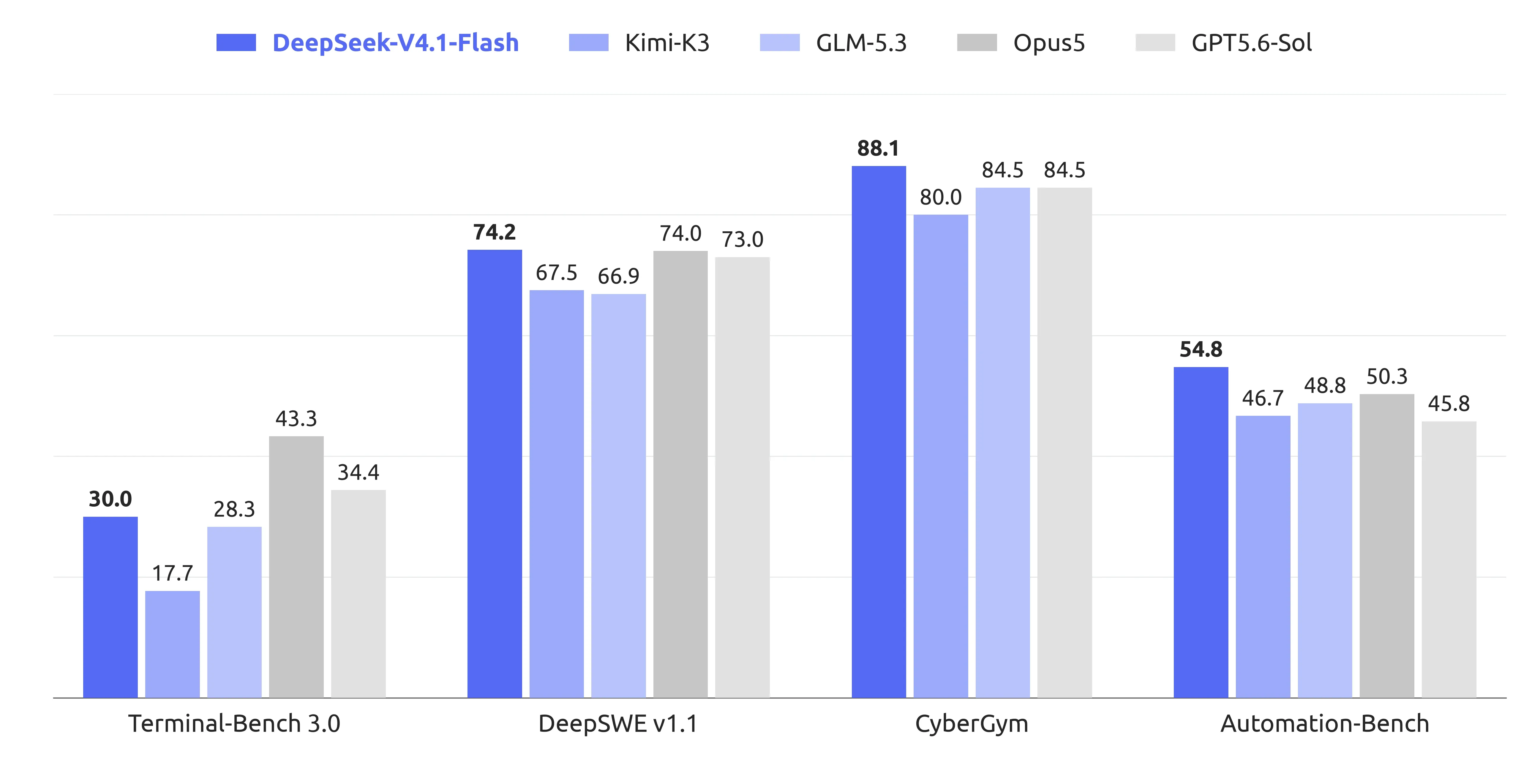
Across systems administration, software development, and agent execution benchmarks, V4.1-Flash performs competitively against significantly larger models:
Benchmark Evaluation Matrix (from Technical Report Table 3):
┌───────────────────────────┬─────────────┬─────────────┬──────────────┬─────────────┐
│ Benchmark Metric          │ V4.1-Flash  │ V4-Pro      │ Opus 5.0     │ GPT-5.6 Sol │
├───────────────────────────┼─────────────┼─────────────┼──────────────┼─────────────┤
│ Terminal-Bench 2.1        │ 90.6        │ 85.2        │ 89.1         │ 88.8        │
│ DeepSWE v1.1 (Resolved)   │ 74.2%       │ 62.7%       │ 74.0%        │ 73.1%       │
│ CyberGym (Security Tasks) │ 88.1        │ 79.4        │ 86.3         │ 84.5        │
│ AutomationBench           │ 54.8        │ 46.1        │ 50.3         │ 52.0        │
│ Agent's Last Exam         │ 31.8        │ 24.5        │ 29.4         │ 30.1        │
│ HLE (with Tool Access)    │ 63.9        │ 58.2        │ 63.6         │ 62.8        │
│ Codeforces Rating         │ 3471        │ 3348        │ 3390         │ 3410        │
│ MathArena Apex            │ 65.6%       │ 65.3%       │ -            │ -           │
└───────────────────────────┴─────────────┴─────────────┴──────────────┴─────────────┘
On Terminal-Bench 2.1, which measures an agent’s ability to operate inside Linux environments, diagnose system states, resolve file system failures, and configure network daemons, V4.1-Flash scored 90.6, leading both Claude Opus 5 (89.1) and GPT-5.6 Sol (88.8).
On the DeepSWE v1.1 software engineering evaluation, testing automated issue resolution across production GitHub codebases, V4.1-Flash resolved 74.2 percent of tasks. This represents a significant improvement over DeepSeek-V4-Pro (62.7 percent) and places it on par with Claude Opus 5 (74.0 percent).
Evaluation across third-party agent harnesses (Table 4 in the report), including Claude Code, Codex, OpenCode, and mini-SWE, showed consistent task resolution between 69.8 and 74.2 percent, confirming stability across varied prompting scaffolds.
The broader evaluation matrix highlights general capabilities alongside specific performance gaps.
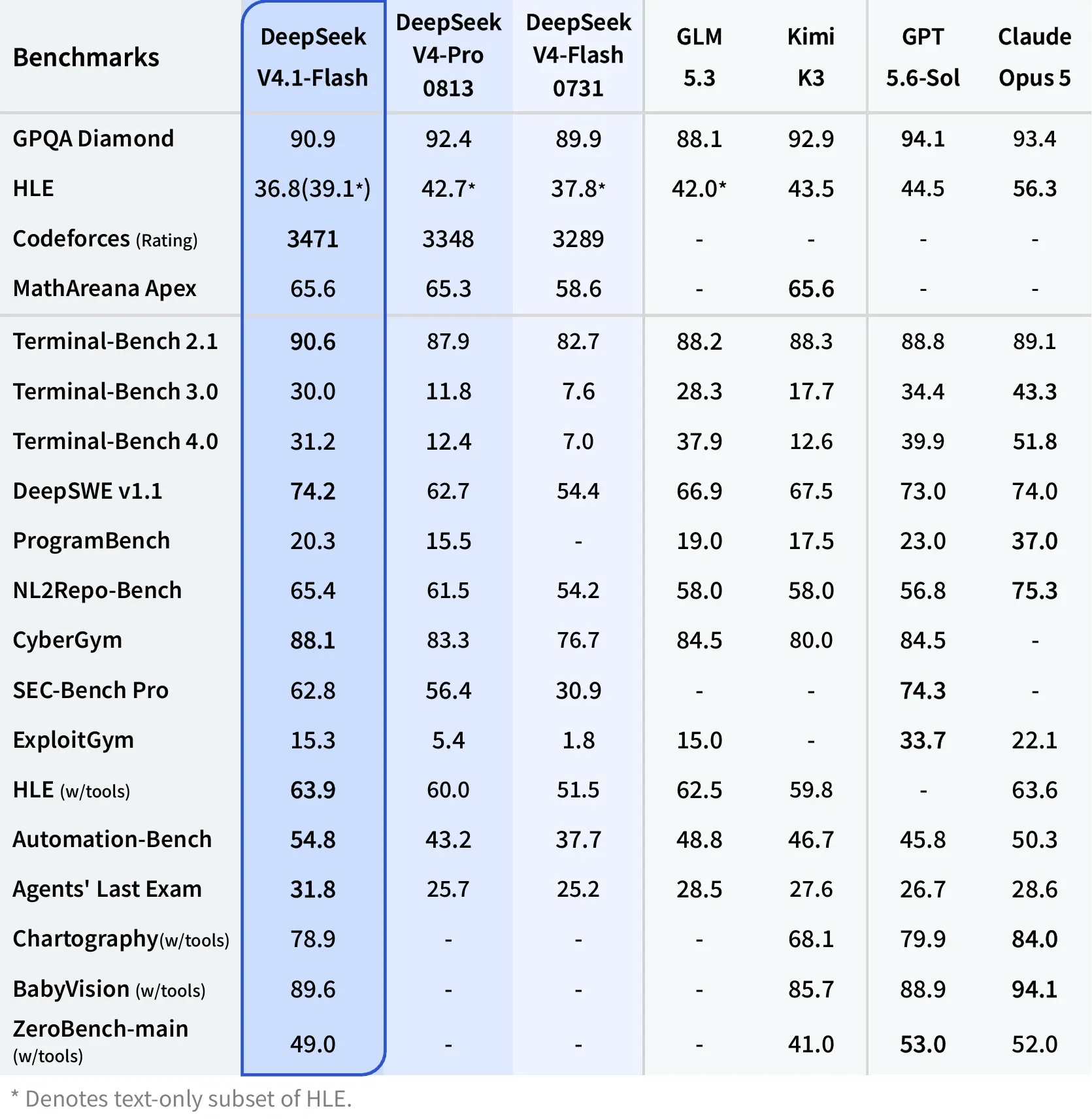
Frontier closed systems retain advantages in two specific operational profiles:
- Formal Scientific Reasoning. On GPQA Diamond, OpenAI’s GPT-5.6 Sol leads at 94.1 percent compared to 90.9 percent for V4.1-Flash.
- Extended Multi-Step Terminal Planning. On Terminal Bench 3.0, evaluating complex autonomous terminal workflows spanning hundreds of sequential steps, Claude Opus 5 maintains an advantage at 43.3 versus 30.0 for V4.1-Flash. On Terminal-Bench 4.0, Opus 5 leads at 51.8 versus 31.2 for V4.1-Flash.
For advanced theoretical physics and unconstrained long-horizon exploratory planning, closed frontier models retain an empirical edge. For day-to-day software development, systems administration, security evaluations, and operational tooling, V4.1-Flash matches frontier performance with significantly lower operating requirements.
Cloud Economics: API Pricing and V4-Pro Deprecation
Model efficiency directly shapes cloud serving economics. In conjunction with the model release, DeepSeek instituted aggressive API repricing and announced the immediate deprecation of its prior flagship model.
Starting September 14, 2026, all API requests directed to deepseek-v4-pro will route to deepseek-v4.1-flash, billed under the Flash pricing schedule until V4.1-Pro launches.
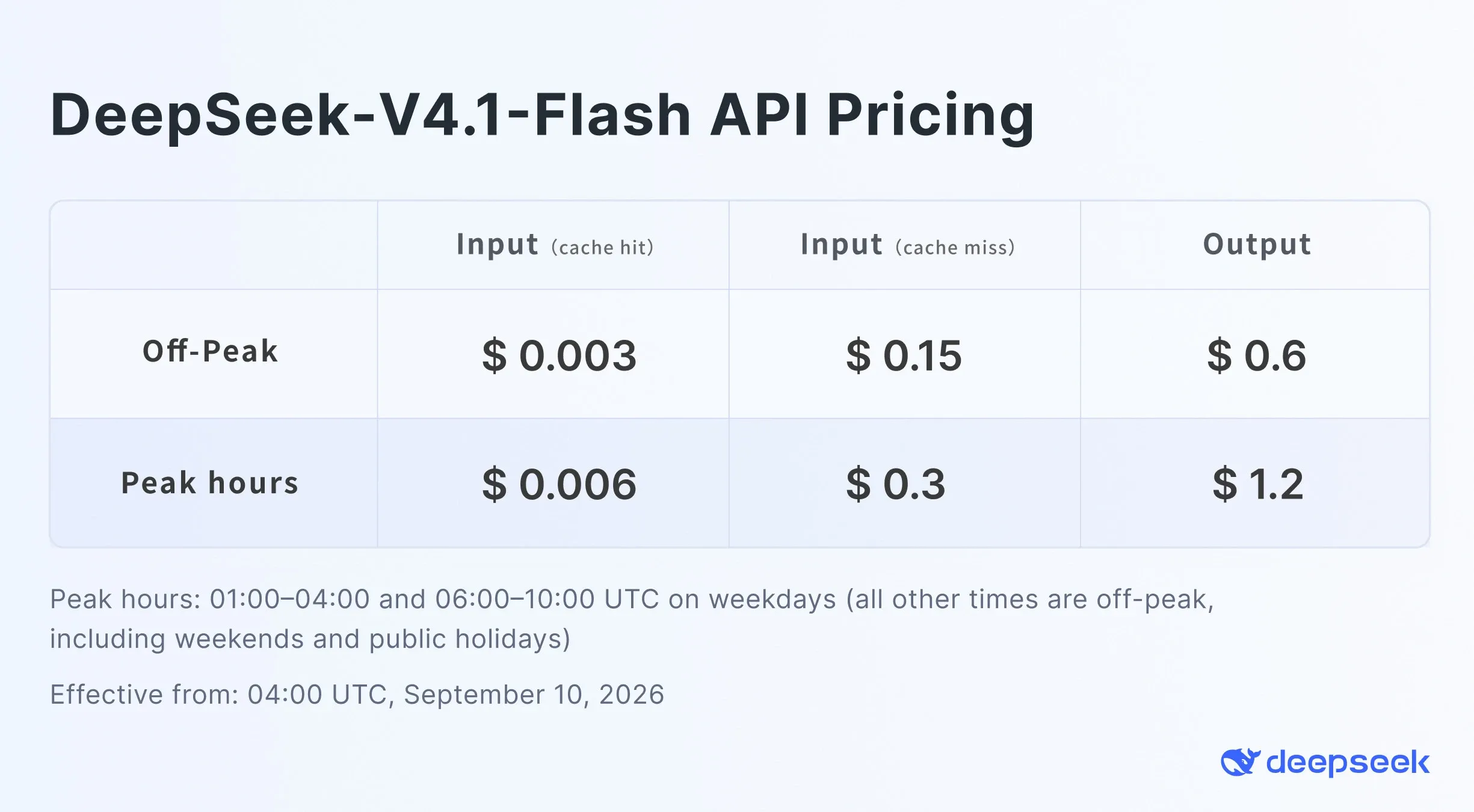
The official API rate card reflects the efficiency gains of the underlying architecture:
DeepSeek-V4.1-Flash API Rate Schedule (per 1 Million Tokens):
┌────────────────────────────┬────────────────────┬────────────────────┐
│ Workload Category          │ Peak Hours Rate    │ Off-Peak Rate      │
├────────────────────────────┼────────────────────┼────────────────────┤
│ Input (Cache Miss)         │ $0.30              │ $0.15              │
│ Input (Cache Hit)          │ $0.006             │ $0.003             │
│ Output Generation          │ $1.20              │ $0.60              │
└────────────────────────────┴────────────────────┴────────────────────┘
For existing users of V4-Pro, output token costs drop from $3.96 per million to $1.20 during peak hours, marking a 70 percent price reduction.
During off-peak windows, output token pricing drops to $0.60 per million tokens, while cache-hit input pricing falls to $0.003 per million tokens (three-tenths of a cent per million tokens).
In comparison, commercial closed models such as Claude Opus 5 operate at list prices of approximately $15.00 per million input tokens and $75.00 per million output tokens. Running DeepSeek-V4.1-Flash during off-peak windows ($0.15 input / $0.60 output) creates an 86-fold cost differential on output token generation.
For engineering organizations deploying automated coding agents that process twenty million tokens of codebase context daily, this alters the operational cost structure from hundreds of dollars per day to nominal utility expenses.
The economic model also accounts for DeepSeek’s operational expansion. The organization announced approximately 150 open technical positions targeting backend infrastructure, elastic scheduling, and distributed GPU batching. Cui Tianyi, who leads the DeepSeek Harness project, noted that managing exponential complexity across data volumes, evaluation workloads, and agent environments requires completely re-architecting serving infrastructure.
Operational Recommendations for Production Deployments
For teams integrating DeepSeek-V4.1-Flash via API or deploying the MIT-licensed model weights on internal infrastructure, four operational factors should guide implementation:
1. Optimize Context Layout for Cache Hits
With cache-hit input priced at $0.003 to $0.006 per million tokens compared to $0.15 to $0.30 for misses, prompt construction directly governs API expenditure.
Static reference material (system instructions, repository directory maps, database schemas) should be placed strictly at the beginning of the prompt. Dynamic variables such as request identifiers or timestamps must not be prepended to the prefix. Consistent prefixes enable the inference engine to utilize warm persistent KV caches, lowering prompt processing costs by up to 98 percent.
Managing prefix consistency prevents unexpected operational expenditure spikes, a challenge examined in our analysis of AWS Free Tier billing traps.
2. Infrastructure Sizing for Self-Hosted Inference
Teams hosting V4.1-Flash on private hardware must evaluate host memory specifications alongside GPU VRAM.
Because the Engram module places 196 billion parameters in host DRAM, target compute nodes require at least 512GB of high-speed DDR5 memory, paired with PCIe Gen5 or high-bandwidth interconnects to facilitate low-latency RDMA transfers.
In containerized deployments, memory allocations and cgroups must provide adequate buffer thresholds. Failure to account for memory spikes during simultaneous prefill operations can trigger container terminations via exit code 137, an issue outlined in our guide to troubleshooting Docker OOMKilled container crashes.
3. Workload Batch Scheduling
Given that off-peak rates represent a 50 percent discount relative to peak pricing, asynchronous batch workloads (codebase indexing, test generation, documentation analysis) should be scheduled during low-demand operating windows.
Production clusters should monitor queuing latency and cache-hit distributions using established observability pipelines, as discussed in our infrastructure monitoring tools comparison.
4. Generation Hyperparameters
DeepSeek recommends specific runtime parameters in its technical documentation to maintain reasoning stability:
sampling_params = {
    "temperature": 1.0,
    "top_p": 0.95,
    "max_tokens": 262144, # 256k reasoning headroom
}
Lowering temperature to extreme values restricts exploration during chain-of-thought derivation. Setting adequate output token ceilings ensures complex reasoning trajectories resolve without premature truncation.
Architectural Summary and Technical Takeaways
Analyzing the technical specifications of DeepSeek-V4.1-Flash clarifies the mechanisms behind its performance claims:
Architectural Specifications Summary:
┌──────────────────────────────┬──────────────────────────────────────────────┐
│ Subsystem Component          │ Engineering Implementation                   │
├──────────────────────────────┼──────────────────────────────────────────────┤
│ Language Backbone            │ 40-layer Transformer (20 Encoder / 20 Decoder)│
│ Active Parameter Profile     │ 8B Prefill / 16B Decode (552B Total Backbone)│
│ Prefill Complexity           │ O(N * L / 2) via Causal Encoder-Decoder      │
│ Global KV Cache Footprint    │ 890 Bytes/Token (4-bit FP4 MXFP4 E2M1)       │
│ Transient Memory Tiering     │ SWA Bounded Replay using 10% Host DRAM Pool  │
│ Factual Memory Storage       │ 196B Parameters in Host DRAM via Engram FP8  │
│ Speculative Generation       │ 3-layer DSpark with Markov Covariance Head   │
│ Multimodal Input Pipeline    │ DeepSeek-ViT with 2D-RoPE & 3x3 Downsampling │
└──────────────────────────────┴──────────────────────────────────────────────┘
The release of DeepSeek-V4.1-Flash reflects a broader transition in artificial intelligence engineering. The early phase of large language model development prioritized scaling raw parameter counts and accumulating computing clusters. While scaling laws remain foundational, the current deployment bottleneck is the physical memory hierarchy of modern datacenters.
By re-architecting the Transformer memory pipeline across prefill computation, KV cache compression, persistent storage tiering, and host memory offloading, DeepSeek has demonstrated that frontier-level agentic capabilities can operate within manageable hardware envelopes.
For systems engineers and infrastructure architects, the primary operational challenge is no longer waiting for cheaper computing hardware. The priority is structuring software and orchestration layers to fully exploit these architectural efficiencies.
Frequently asked questions
What is DeepSeek V4.1 Flash?
DeepSeek V4.1 Flash is an open-weight 552-billion parameter MoE model engineered for long-context efficiency, reducing KV cache footprint to 890 bytes per token.
How does DeepSeek V4.1 Flash reduce KV cache size to 890 bytes?
It combines a Causal Encoder-Decoder structure with Compressed Sparse Attention 2, FP4 cache quantization, and SWA Bounded Replay to cut memory requirements.
What are the active parameter counts during prefill and generation?
DeepSeek V4.1 Flash activates 8 billion parameters during input prefill and 16 billion parameters during output generation across 384 finely routed experts.
How is your infrastructure team adapting memory allocations and prompt caching strategies for long-context agent workloads? Share your operational findings in the comments below.
Implementation Checklist
- Replicate the steps in a controlled lab before production changes.
- Document configs, versions, and rollback steps.
- Set monitoring + alerts for the components you changed.
- Review access permissions and least-privilege policies.
Official References
Need a Hand?
If you want this implemented safely in production, I can help with assessment, execution, and hardening.
Contact MeDeploy on Cloud Infrastructure with $200 Free Credit
Spin up high-performance SSD cloud Droplets, managed Kubernetes, and databases in seconds. Test your containers and production workloads with $200 in free credits.
Transparency: We independently test and operate all recommended infrastructure. If you use our partner links, you receive free promotional credits and support our testing lab at zero extra cost to you.
Weekly Production DevOps Runbooks
Join 1,000+ infrastructure engineers receiving real-world Linux troubleshooting, Proxmox clustering setups, and Docker optimization runbooks every Tuesday. Zero spam, unsubscribe anytime.
About the Author
Kamandanu Wijaya
IT Infrastructure & Network Administrator
Infrastructure & network administrator with 15+ years of enterprise experience, focused on stability, security, and automation.
Certifications: Google IT Support, Cisco Networking Academy, DevOps.
Proxmox Quorum Loss: Fix Corosync and Split-Brain Loops
Next →ZFS vs Btrfs on Linux: Snapshots, RAID, and RAM Overhead
Need IT Solutions?
DoWithSudo is ready to help setup servers, VPS, and your security systems.
Contact Us