The IT Support Trap, When Comfort Zone Kills Your Career Growth

The clock strikes 4:00 PM. I just closed the last ticket of the day. It was a classic cliché, the copy printer machine on the first floor had a paper jam, and a user in another department forgot their email password again for the second time this week.
In this article, we cover IT Support career in a practical way so you can apply it with confidence.
I took a sip of the cold coffee left on my desk, leaned back in my ergonomic chair that was quite comfortable, and felt a sense of satisfaction. “Today was smooth,” I thought. The pay is decent, the work isn’t too stressful, and I can go home on time to binge watch Netflix.
But beneath that superficial satisfaction, a quiet voice in my head was getting louder every day: “How long are you going to keep doing this?”
This is a story about the sweetest trap in an IT career. The Comfort Zone. And maybe, just maybe, it’s your story too.
The routine that lulls you to sleep
Starting as IT Support or Helpdesk is often our first gateway into the professional tech world. It feels great. You are the “smart tech guy” in the office. People need you. When you fix the Wifi just by rebooting the router, they look at you like you’re a wizard.
The first year is amazing. You learn hardware troubleshooting, Windows installation, basic MikroTik configuration, and crimping LAN cables. The second year, you start memorizing the patterns of problems in the office. The third year? You can solve issues with your eyes closed.
This is where the danger begins.
When your job starts feeling “too easy,” it doesn’t mean you’ve mastered tech. It means you’ve stopped growing. The routine of fixing printers and reimaging Windows slowly dulls your technical edge. You feel busy, but in reality, you are running on a treadmill moving fast but going nowhere.
The curse of the “sort-of generalist”
The biggest problem with staying in IT Support too long is that we are forced to “Know a Little Bit About Everything.”
- Know Linux? “A little, I installed Ubuntu once.”
- Know networking? “I get the difference between static and dynamic IP.”
- Know coding? “I edited some HTML once.”
We become Generalists. On one hand, this is good; we are flexible. But in an industry that demands specialization, being a generalist without depth is a recipe for disaster.
I once felt incredibly confident because I could fix any gadget in the office. But when I tried applying for a Sysadmin or Junior DevOps role at a startup, reality slapped me in the face. They didn’t need someone who “knows a little bit.” They needed someone who deeply understood Nginx configuration, Docker management, or automation with Ansible.
My skill in replacing printer cartridges was worthless there. It hurt. It was like realizing the knife you’d been sharpening for years was just a butter knife, while the world was looking for a samurai sword.
The fear of being a beginner again
Why is it so hard to pivot? The answer is simple: Ego.
As a IT Support staff, we might earn a decent salary. We are respected by users. We are the “Kings of the Hill.” To learn a new skill say, Cloud Computing or Containerization we have to be willing to be “dumb” again. We have to start from zero. Struggling with Linux command errors. Getting confused by complex documentation.
Feeling “dumb” isn’t fun. It feels much better to stay in our lane, fixing slow laptops, and feeling smart. But remember the old saying: “If you are the smartest person in the room, you are in the wrong room.”
IT support is a runway, not a parking lot
Don’t get me wrong. I am not looking down on IT Support. This role is crucial. Without IT Support, office operations crumble. My point is: Use it as a stepping stone, not a parking lot.
The experience of dealing with frustrated users gives us a very expensive soft skill, Empathy and Communication. A Sysadmin or Developer who has never been in IT Support often builds systems that are technically brilliant but practically unusable for humans. We have that edge. We know how frustrated users get when a system is slow or the UX is confusing.
Use your “downtime” at the office not for gaming, but for learning. Remember that old server in the warehouse gathering dust? Ask your boss if you can turn it into a lab. Install Linux Server on it. Try to build a web server. Break it. Reinstall it. Try setting up Docker. Try setting up monitoring.
Small steps to escape the trap
If this article feels like a slap in the face, good. That means the fire is still there. It’s not too late to change.
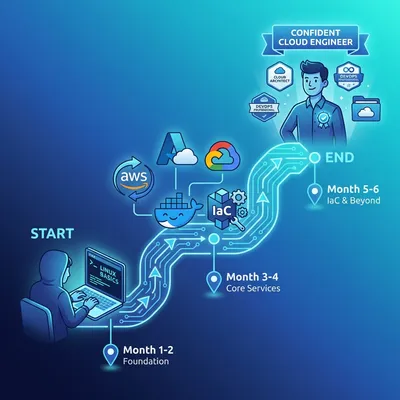
- Pick One Path: The IT world is vast. Don’t be greedy. Pick one lane, Networking (Network Engineer)? Systems (Sysadmin/DevOps)? Or Security (Cybersecurity)?
- Go Deep, Not Wide: If you pick Sysadmin, don’t just learn “how to install.” Learn “how it works.” Why does a web server need port 80? What is DNS propagation?
- Find Side Projects: Not to make extra money, but to make extra problems for yourself to solve. Host your own blog on a cheap VPS. Force yourself to touch that black terminal screen.
Need ideas on where to start? Try learning Docker containerization or Ansible automation. Both skills are highly sought after in the industry and can be learned with a simple virtual server.
Closing: comfort is the enemy of growth
Leaving your comfort zone is terrifying. You will fail. You will get headaches trying to understand Kubernetes configs. But that headache is the feeling of your brain stretching, growing.
Five years from now, you won’t regret the late nights spent learning hard things. You will only regret it if, five years from now, you are still the same person, in the same chair, complaining about the user who forgot their email password again.
Start today. One YouTube tutorial, one page of documentation, one line of code. Anything, just don’t stand still.
Keep pushing, friends. The road ahead is long, but worth it. 🚀
I hope this guide on IT Support career helps you make better decisions in real-world situations.

About the Author
Kamandanu Wijaya
IT Infrastructure & Network Administrator
Infrastructure & network administrator with 14+ years of enterprise experience, focused on stability, security, and automation.
Certifications: Google IT Support, Cisco Networking Academy, DevOps.
View ProfileNeed IT Solutions?
DoWithSudo team is ready to help setup servers, VPS, and your security systems.
Contact Us